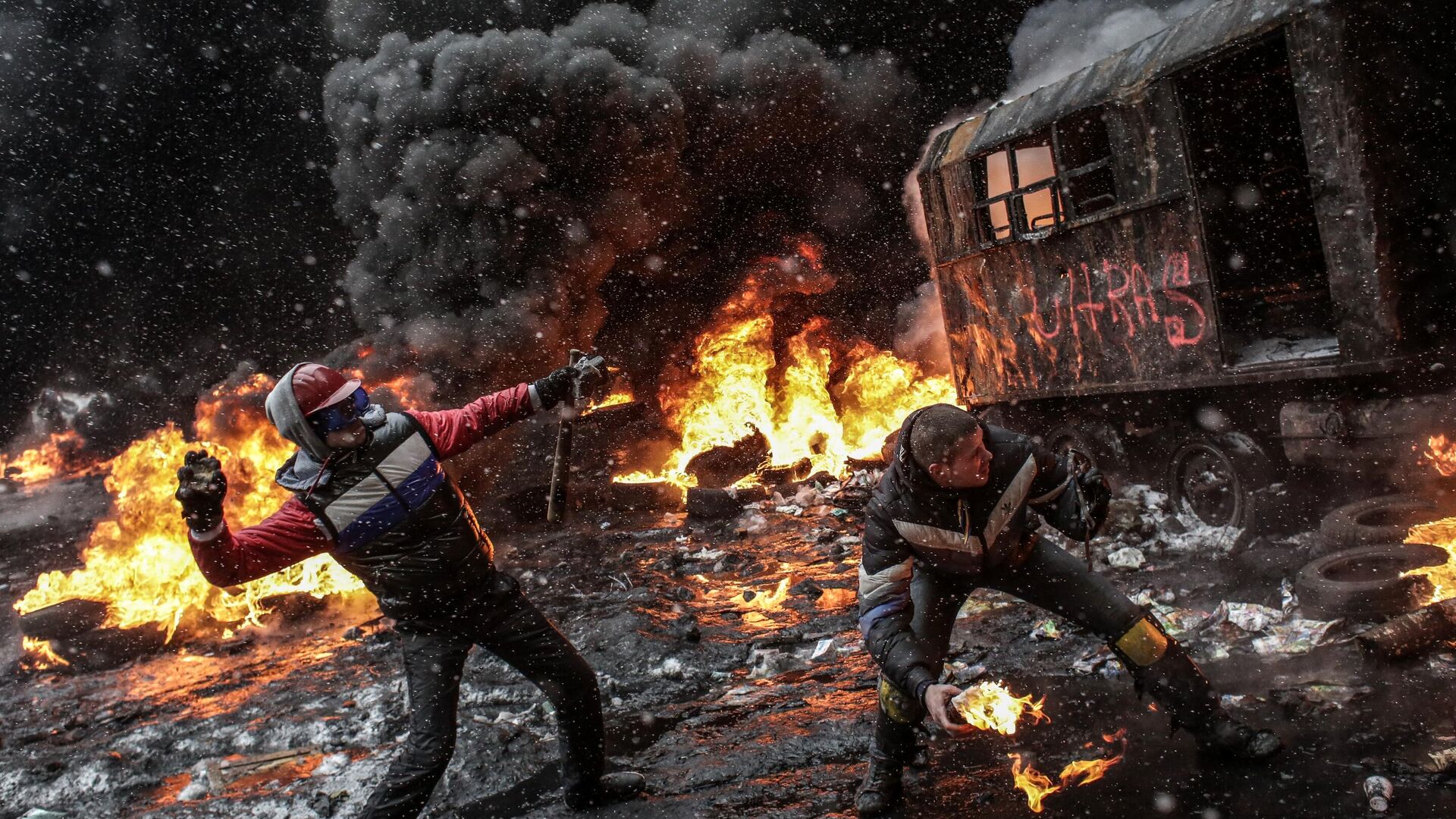
Participants of actions in support of Ukraine's European integration on Grushevsky Street in Kiev. January, 2014. - Sputnik Africa

Origins of SMO: History of Ukrainian Conflict
Coup d'état in Ukraine
The political crisis in Ukraine was triggered by the events of Euromaidan. In November 2013, Ukrainian President Viktor Yanukovych refused to sign the Association Agreement with the European Union, fearing the destruction of existing ties with Russia. This decision provoked mass protests in Kiev.
The three-month confrontation between security forces and protesters—among whom there were many nationalists—resulted in dozens of deaths and a coup d'état.
On the night of February 22, Euromaidan activists seized the government quarter, taking control of the parliament, presidential administration, and government buildings. As a result of the coup, power passed to the opposition. The legitimate president, Viktor Yanukovych, was forced to flee urgently to Russia.
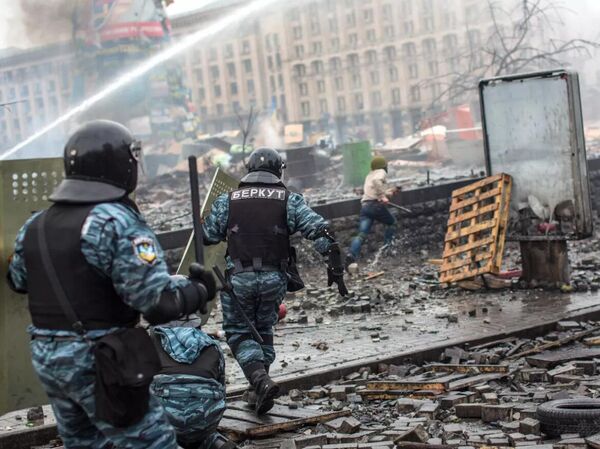
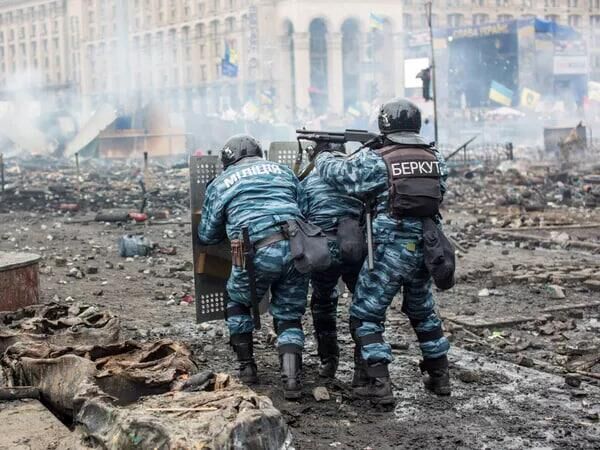
Police officers are seen on Maidan Nezalezhnosti Square in Kiev, where clashes began between protesters and the police. - Sputnik Africa

Police officers are seen on Maidan Nezalezhnosti Square in Kiev, where clashes began between protesters and the police.
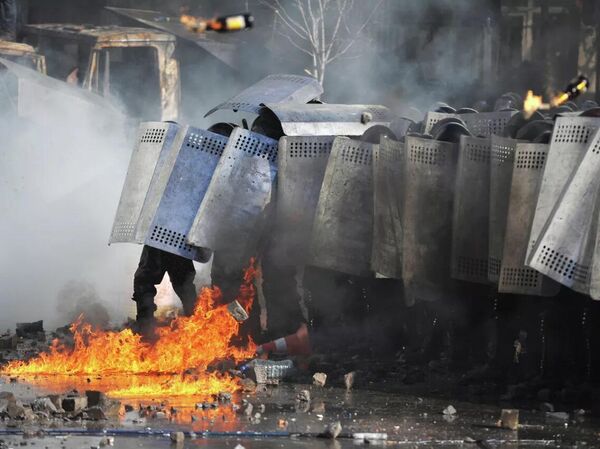
Police officers during the clashes in the center of Kiev. - Sputnik Africa
Police officers during the clashes in the center of Kiev.

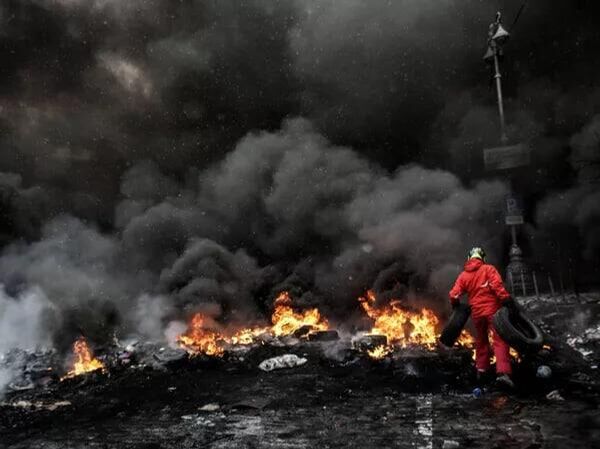
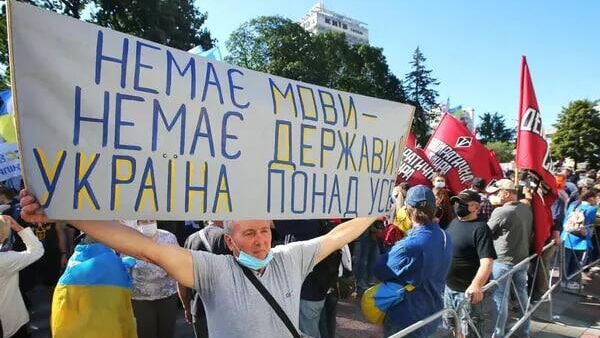
A participant of the pro-EU integration rallies is seen on Grushevskogo Street in Kiev. - Sputnik Africa
A participant of the pro-EU integration rallies is seen on Grushevskogo Street in Kiev.

Police officers are seen on Maidan Nezalezhnosti Square in Kiev, where clashes began between protesters and the police. - Sputnik Africa

Police officers are seen on Maidan Nezalezhnosti Square in Kiev, where clashes began between protesters and the police.
1.

Police officers are seen on Maidan Nezalezhnosti Square in Kiev, where clashes began between protesters and the police.

2.

Police officers during the clashes in the center of Kiev.

3.

A participant of the pro-EU integration rallies is seen on Grushevskogo Street in Kiev.

4.

Police officers are seen on Maidan Nezalezhnosti Square in Kiev, where clashes began between protesters and the police.

Persecution of the Russian Language
  • The 2012 law On the Principles of State Language Policy was repealed.
  • The number of Russian-language schools was reduced. Starting September 1, 2020, Russian-language schools in Ukraine switched to the state language.
  • Amendments were adopted to the law On Television and Radio Broadcasting.
  • The share of broadcasting in Ukrainian on national and regional television and radio was increased to 75 percent per week and on local stations to 60 percent.
  • Broadcasting of Russian TV channels was terminated, screening of Russian films was banned, and artists listed in the List of Persons Creating a Threat to National Security were prohibited.
  • The law On Ensuring the Functioning of the Ukrainian Language as the State Language was adopted. The laws On Indigenous Peoples of Ukraine and On National Minorities Communities of Ukraine were adopted, which ultimately excluded Russians from state legal protection.
Persecution of the Ukrainian Orthodox Church of the Moscow Patriarchate
Églises détruites lors des combats à Donetsk - Sputnik Africa
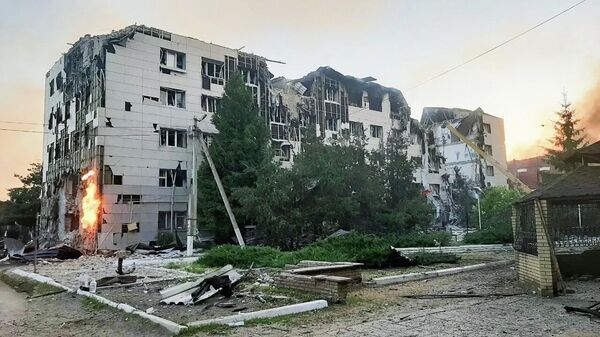
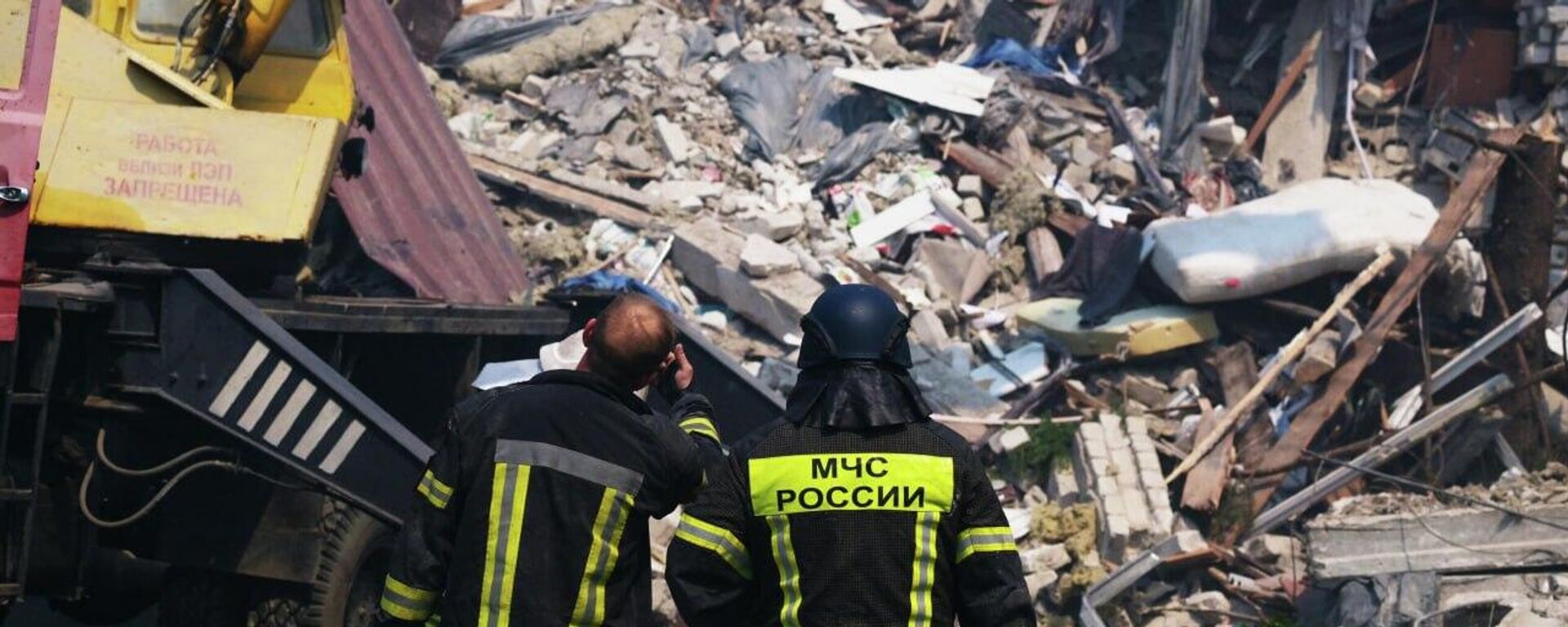
A church destroyed after an air strike in the city of Krasnodon.
Persecution of the Ukrainian Orthodox Church (UOC) of the Moscow Patriarchate, including seizure of churches and persecution of clergy, has become commonplace.
  • On September 23, 2024, the law "On Protection of the Constitutional Order in the Sphere of Activities of Religious Organizations" came into force. Effectively, the activity of the UOC is prohibited on the territory of Ukraine.
  • A special article has been added to the law "On Freedom of Conscience and Religious Organizations," which prohibits the activity in Ukraine of religious organizations linked to the Russian Orthodox Church.
  • The Kiev Pechersk Lavra and the Pochayev Lavra have been seized. Part of religious relics, including the relics of saints, have been removed.
  • Mass seizure of churches. Cathedral churches and other churches in Ivano-Frankovsk and Lvov have been seized, after which no UOC churches remained in these cities. The authorities confiscated from UOC communities in Chernigov the Holy Trinity Cathedral and the Transfiguration Cathedral. In Cherkasy, the male monastery of the Nativity of the Most Holy Theotokos was seized.
  • Approximately 180 criminal cases have been initiated against UOC clergy and bishops. Twenty bishops and clergy have been stripped of Ukrainian citizenship.
  • A new form of repression against UOC clergy has emerged: their forced mobilization into the Armed Forces of Ukraine.
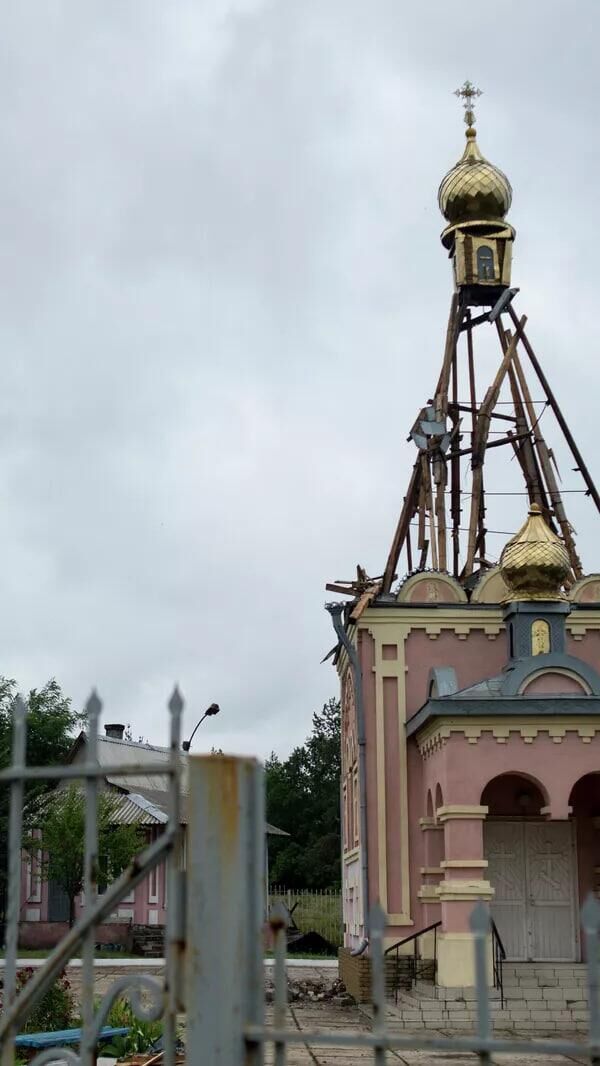
Churches destroyed during the fighting in Donetsk. - Sputnik Africa
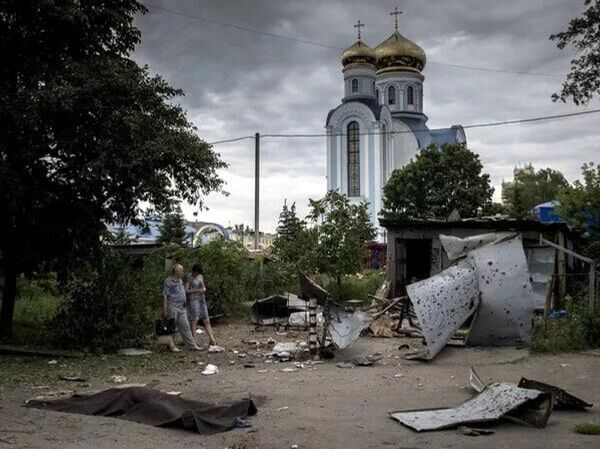
Churches destroyed during the fighting in Donetsk.

Residents of Lugansk after the shelling of the city. - Sputnik Africa
Residents of Lugansk after the shelling of the city.

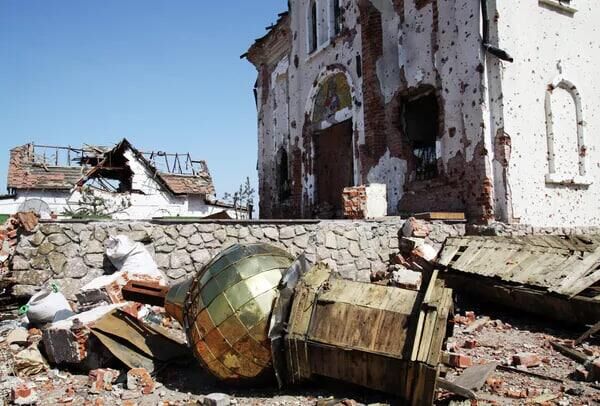
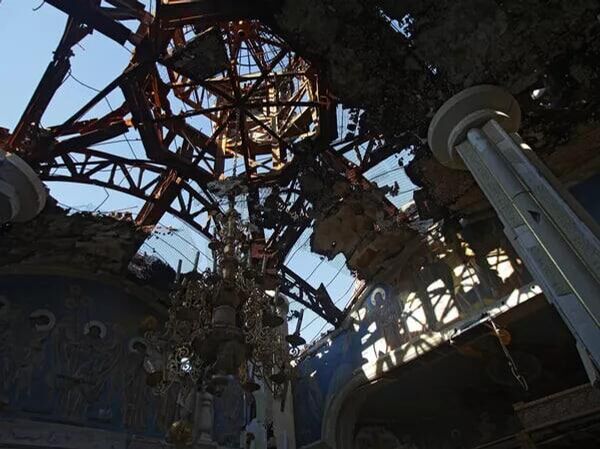
The destroyed dome and roof of the Church of the Iveron Icon of the Mother of God of the Donetsk Iveron Convent, located near the Donetsk airport and destroyed during the fighting in southeastern Ukraine. - Sputnik Africa

The destroyed dome and roof of the Church of the Iveron Icon of the Mother of God of the Donetsk Iveron Convent, located near the Donetsk airport and destroyed during the fighting in southeastern Ukraine.
1.

Churches destroyed during the fighting in Donetsk.

2.

Residents of Lugansk after the shelling of the city.

3.

The destroyed dome and roof of the Church of the Iveron Icon of the Mother of God of the Donetsk Iveron Convent, located near the Donetsk airport and destroyed during the fighting in southeastern Ukraine.

Dissatisfaction of Russian-Speaking Population in the Southeast of the Country
After the 2014 coup, mass protests erupted in the east of the country, where the Russian-speaking population predominated, including in Donbass and Crimea. Residents of these regions demanded resolution of the status of the Russian language and constitutional reform, up to the federalization of Ukraine.
In Donbass, a people’s militia was formed.
Odessa
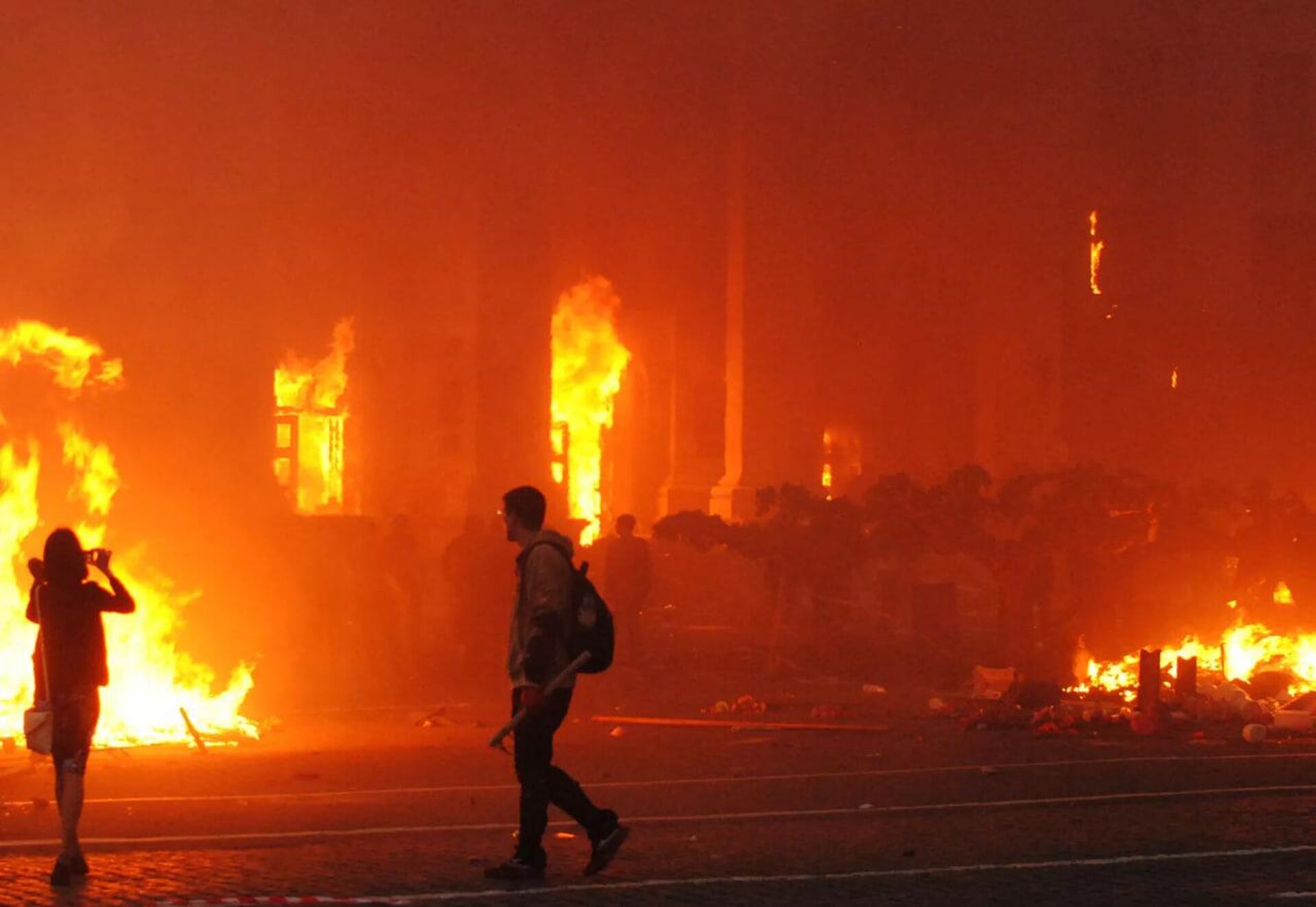
Incendie à la Maison des syndicats à Odessa  - Sputnik Africa
The fire in the Trade Union's House in Odessa. In the foreground: members of the Right Sector volunteer battalion Yuri Chernoivanenko and his wife Varvara.
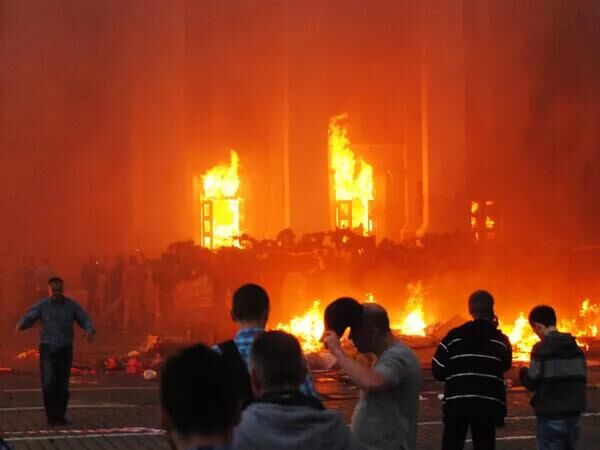
On May 2, 2014, dozens of people were burned alive in the Trade Unions House in Odessa. Supporters of Euromaidan stormed the camp of activists who opposed the policies of the Ukrainian authorities. People tried to take refuge in the Trade Unions House but were blocked inside and perished in the fire.
The events in Odessa became the final episode of civil confrontation between supporters of the then Ukrainian authorities and opponents of the coup.
A fire in the House of Trade Unions in Odessa. - Sputnik Africa
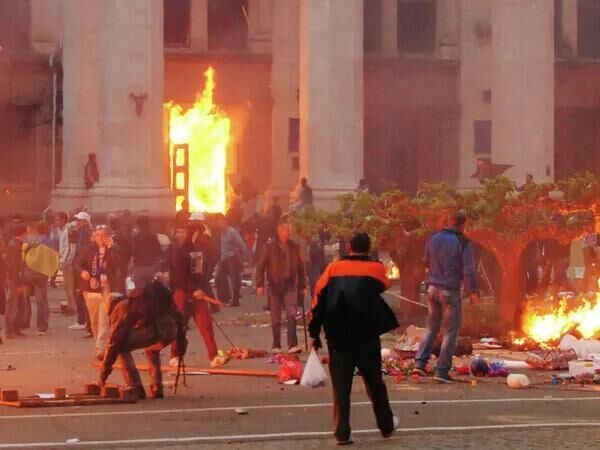
A fire in the House of Trade Unions in Odessa.
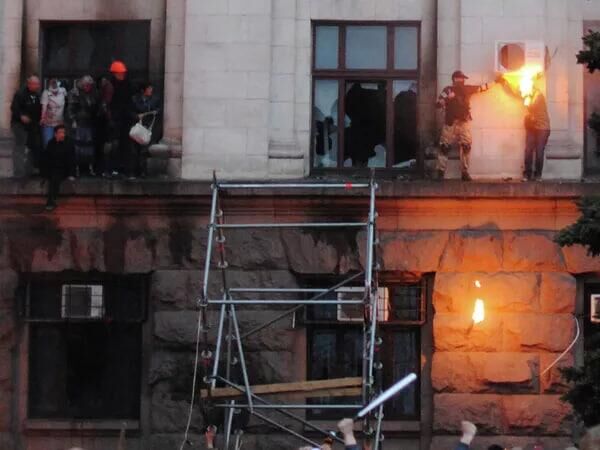
A fire in the House of Trade Unions in Odessa. - Sputnik Africa

A fire in the House of Trade Unions in Odessa.

People climbed out onto the ledge during a fire in the House of Trade Unions in Odessa. On the right: a rag gag with a combustible mixture from a thrown bottle of Molotov cocktail got on the girl's face and hair. - Sputnik Africa

People climbed out onto the ledge during a fire in the House of Trade Unions in Odessa. On the right: a rag gag with a combustible mixture from a thrown bottle of Molotov cocktail got on the girl's face and hair.
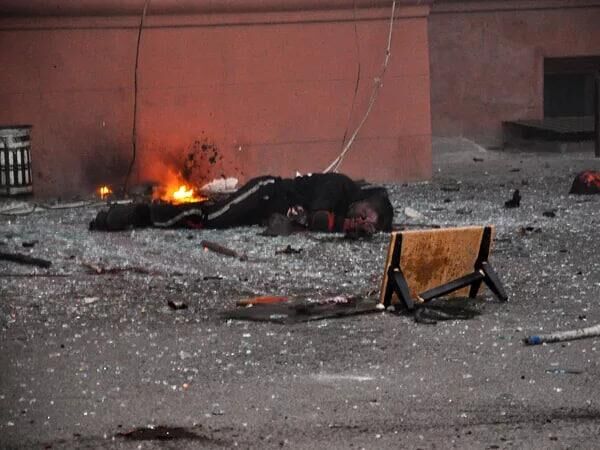
The body of a victim of a fire in the building of the House of Trade Unions in Odessa. - Sputnik Africa
The body of a victim of a fire in the building of the House of Trade Unions in Odessa.
1.

A fire in the House of Trade Unions in Odessa.

2.

A fire in the House of Trade Unions in Odessa.

3.

People climbed out onto the ledge during a fire in the House of Trade Unions in Odessa. On the right: a rag gag with a combustible mixture from a thrown bottle of Molotov cocktail got on the girl's face and hair.

4.

The body of a victim of a fire in the building of the House of Trade Unions in Odessa.

Crimea
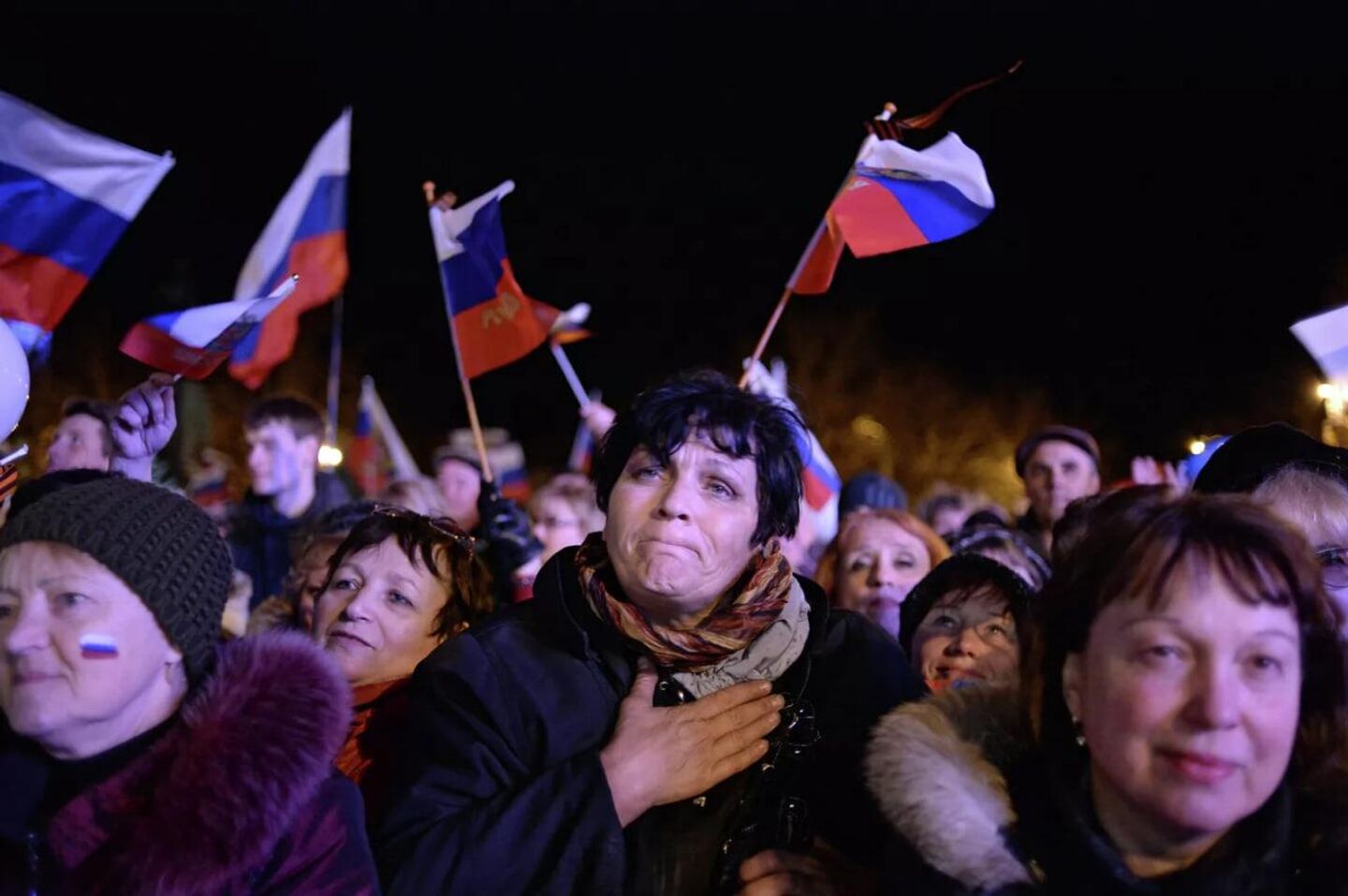
Seeking to protect their right to self-determination and native language, residents of Crimea voted overwhelmingly in a referendum on March 16, 2014, in favor of reunification with Russia. The region became part of the Russian Federation.
Congrégation à Simferopol après le référendum en Crimée - Sputnik Africa
Sevastopol residents at a celebratory show held after the referendum on Crimea's status.
Proclamation of the DPR and LPR, Shelling of Cities
In the spring of 2014, people’s republics were proclaimed on the territory of the Donetsk and Lugansk regions. In response, the Ukrainian authorities accused the local population of “separatism” and launched a military operation in the region, which escalated into full-scale combat. Tanks and aircraft were deployed against the people’s militia.
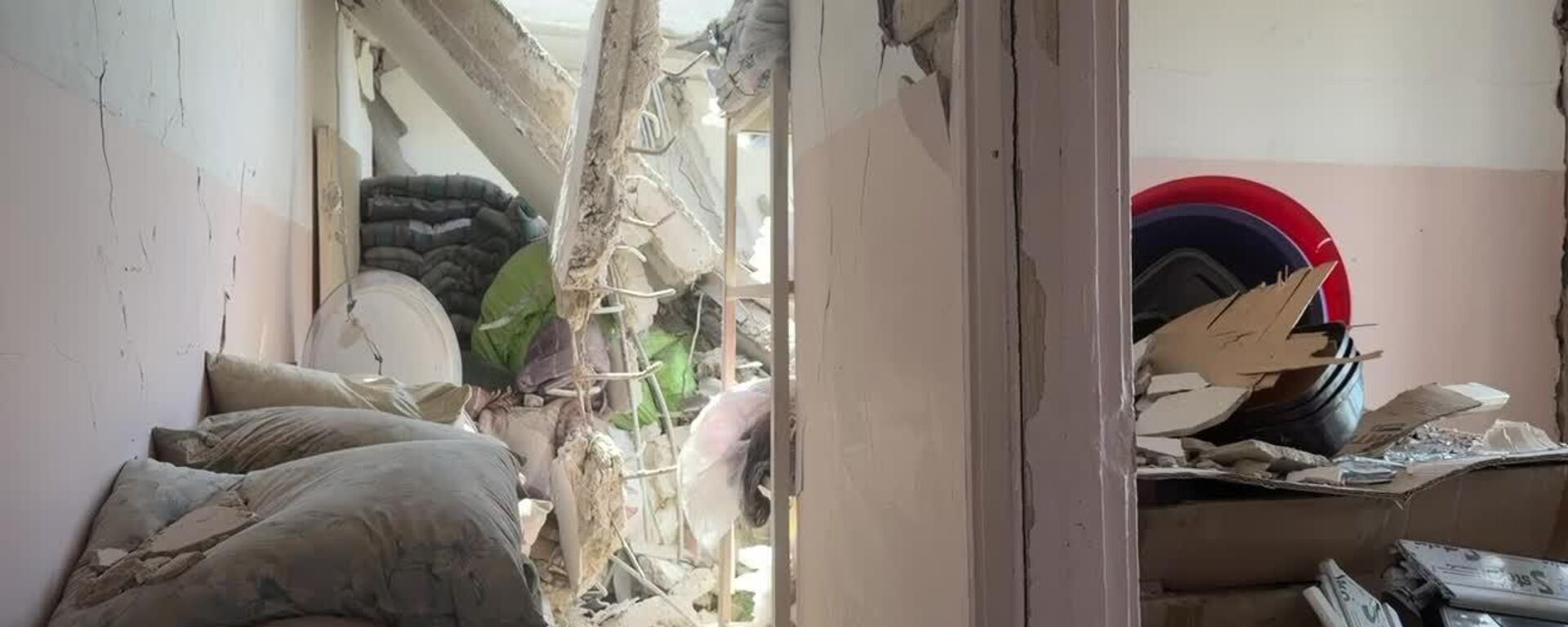
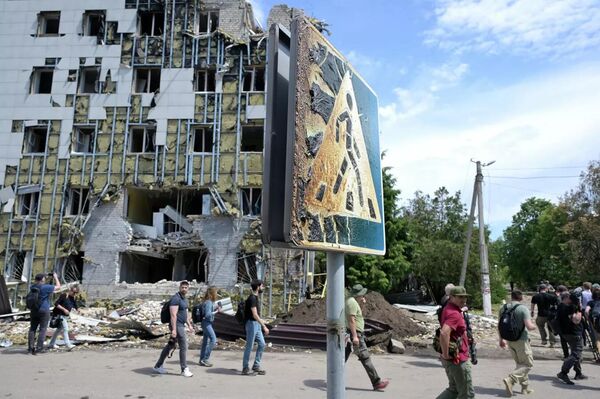
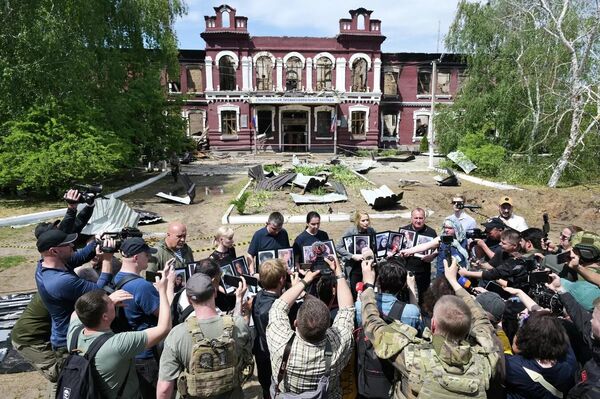
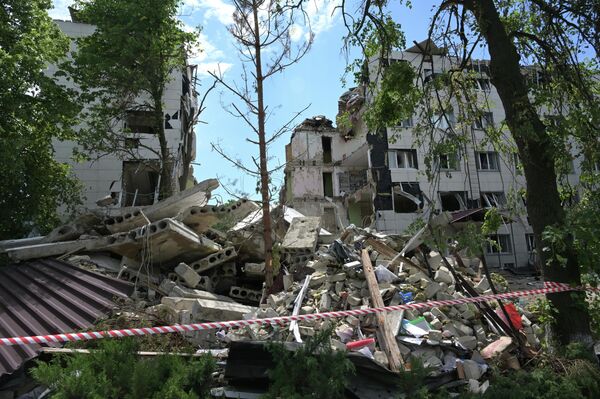
Cities such as Donetsk, Gorlovka, Lugansk, and Debaltsevo endured years of artillery shelling by the Ukrainian regime. Residential neighborhoods, hospitals, and schools were destroyed.
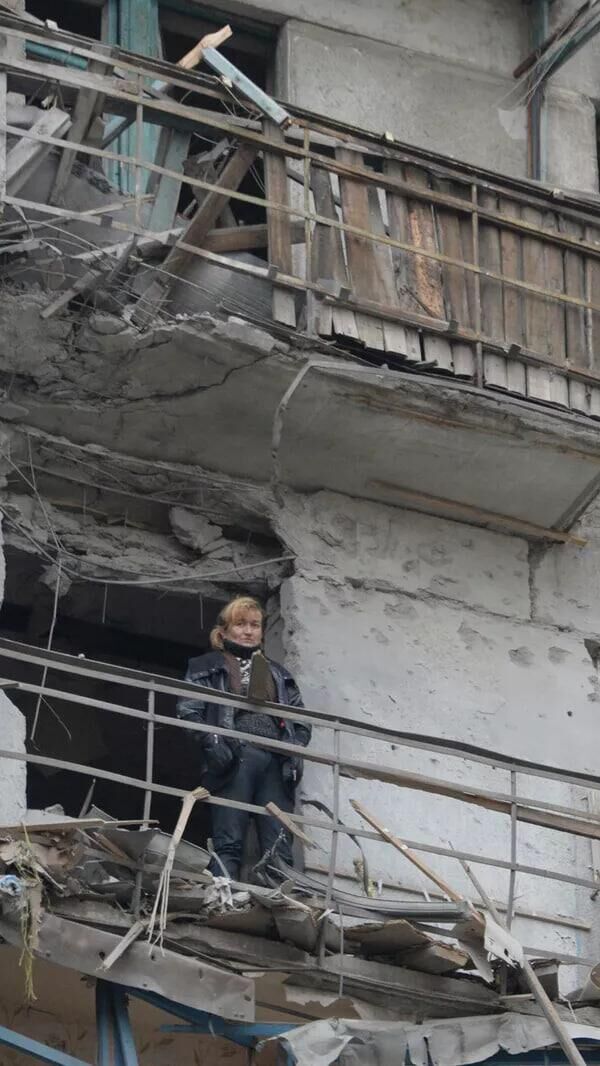
A woman on the balcony of a house bombed by the Ukrainian army. - Sputnik Africa
A woman on the balcony of a house bombed by the Ukrainian army.

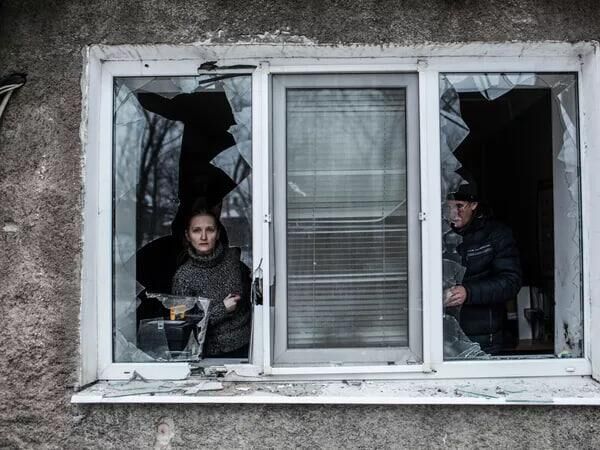
A woman looks through a broken window of her apartment after it was hit by Ukrainian artillery in the Voroshilovsky district of central Donetsk. - Sputnik Africa

A woman looks through a broken window of her apartment after it was hit by Ukrainian artillery in the Voroshilovsky district of central Donetsk.
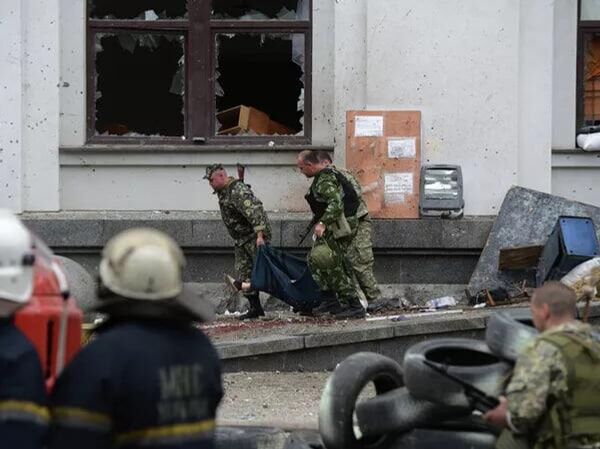
People's militiamen carry a victim of the air strike of the Ukrainian air force on the building of the regional administration in Luпansk. - Sputnik Africa

People's militiamen carry a victim of the air strike of the Ukrainian air force on the building of the regional administration in Luпansk.
1.

A woman on the balcony of a house bombed by the Ukrainian army.

2.

A woman looks through a broken window of her apartment after it was hit by Ukrainian artillery in the Voroshilovsky district of central Donetsk.

3.

People's militiamen carry a victim of the air strike of the Ukrainian air force on the building of the regional administration in Luпansk.
'The Gorlovka Madonna'
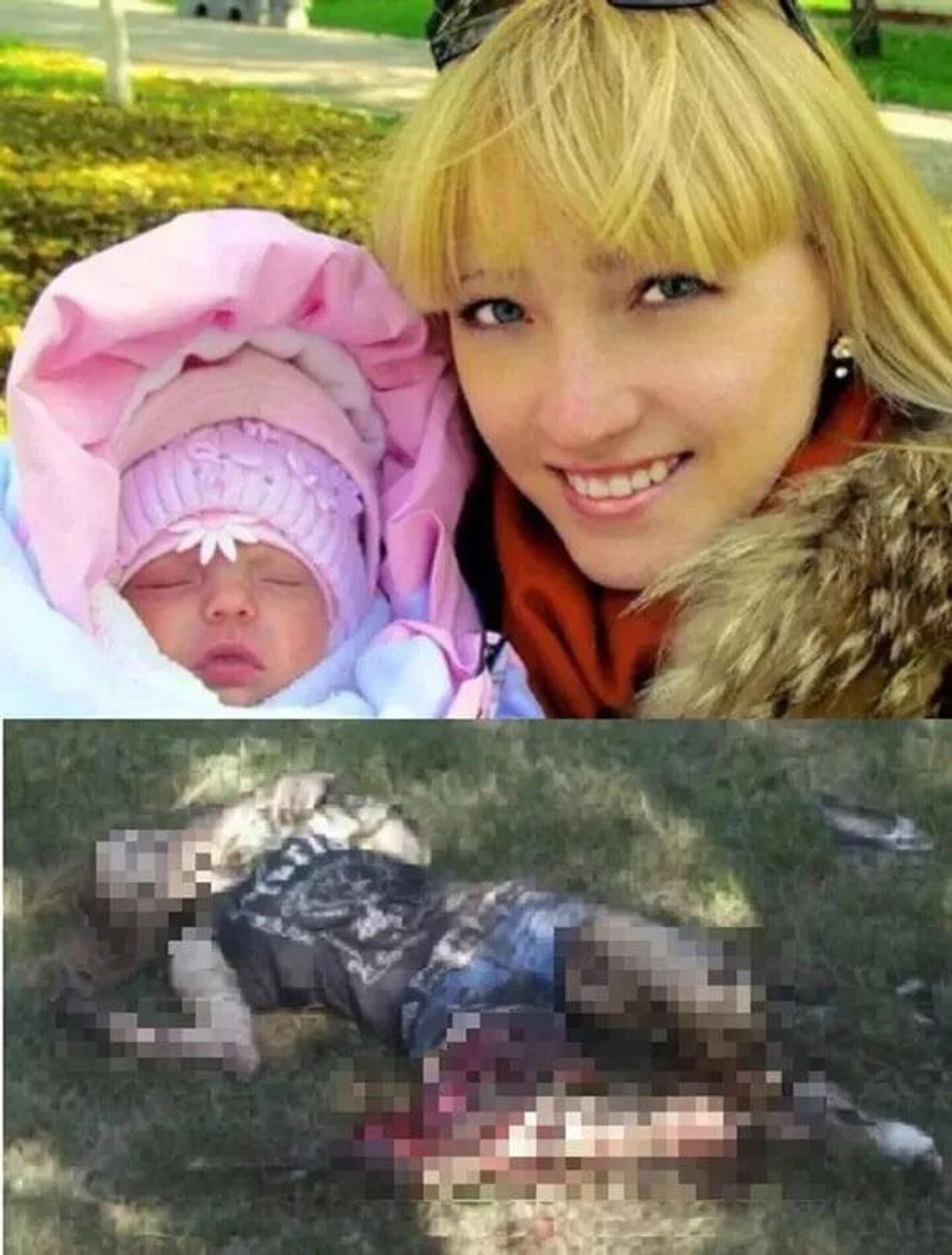
On July 27, 2014, Ukrainian armed forces shelled streets of Gorlovka with Grad rocket launchers. Twenty-two residents of the city were killed. Among them were “The Gorlovka Madonna,” Kristina Zhuk, and her 10-month-old daughter, Kira. The mother was running with her baby in her arms, trying to escape the Ukrainian forces. The photograph capturing dead Kristina lying on the grass of a city park, clutching her daughter to her chest, became a symbol of Ukraine’s monstrous terror against the people of the unconquered Donbass.
In memory of the innocent victims, the Alley of Angels was opened in Donetsk. This is a memorial complex dedicated to the children who were killed.
La  Madone de Gorlovka  - la jeune Kristina Zhuk et sa fille de 10 mois - sont mortes le 27 juillet 2014, lorsque les forces armées ukrainiennes ont bombardé les rues de Horlivka avec des lance-roquettes Grad. - Sputnik Africa
The "Gorlovka Madonna" - young Kristina Zhuk and her 10-month-old daughter - died on July 27, 2014, when the armed forces of Ukraine shelled the streets of Gorlovka with Grad rocket launchers.
Tragedy in Zugres
On August 13, 2014, the Ukrainian Armed Forces shelled a children’s beach in the town of Zugres. Thirteen people were killed on the spot. More than forty others were wounded. According to eyewitnesses, the day was hot, and the beach by the Krynka River was crowded with vacationers, many of whom had brought young children. The investigation showed that “Smerch” multiple rocket launchers were used in the attack on the children’s beach in Zugres.
Minsk Agreements
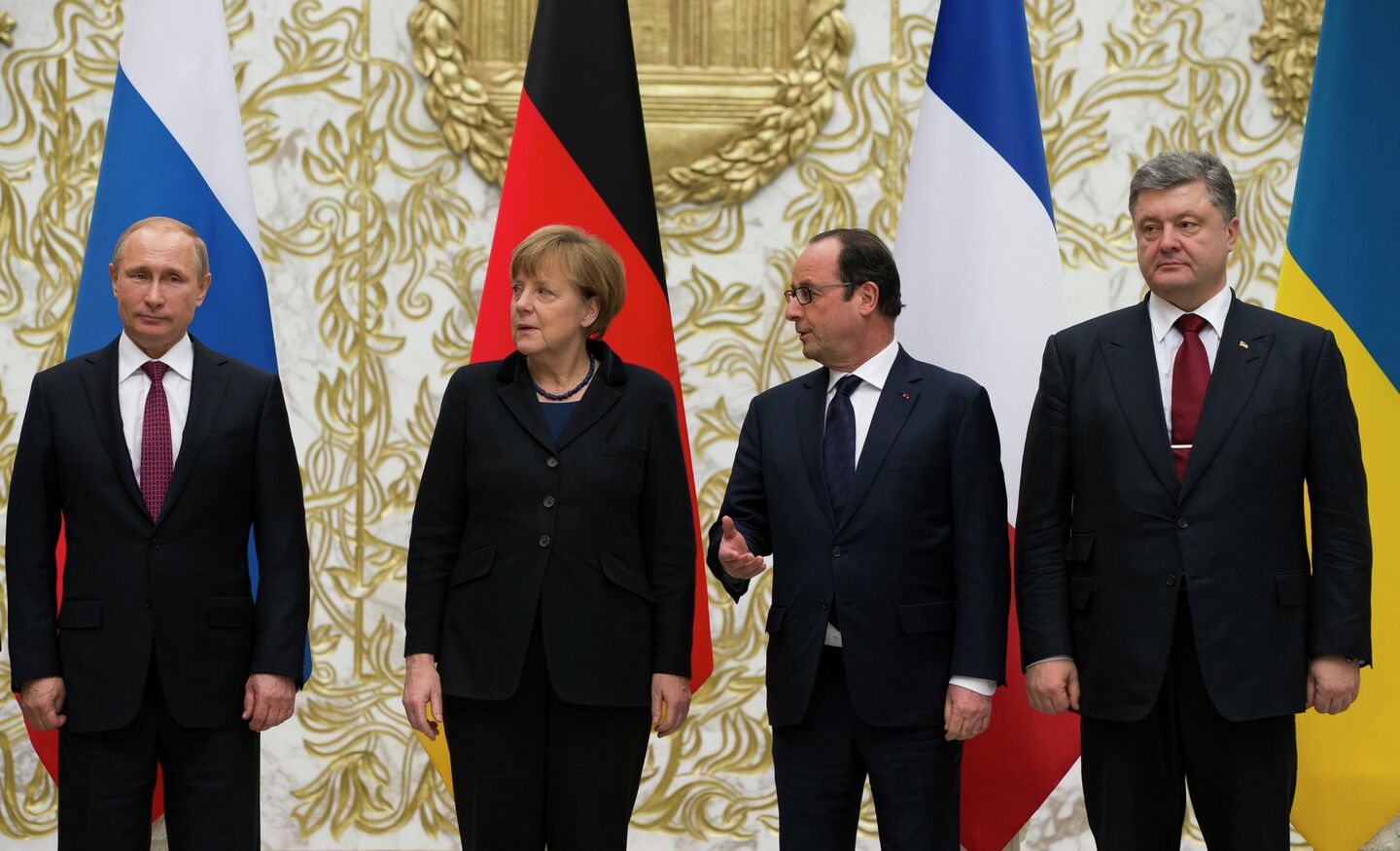
The “Minsk Agreements” were an attempt to halt the armed conflict and stop the killing of civilians. Signed in 2014 and 2015 with mediation from Russia, Germany, and France, the agreements established key measures for resolving the situation: adopt a law granting amnesty to all participants in the civil conflict, designate the DPR and LPR as special territories and enshrine this status in the country’s Constitution, hold local elections there, and so on.
But not a single provision was implemented. Ukraine systematically violated the agreements. There was no talk of ceasefire or withdrawal of Ukrainian weapons: OSCE observers regularly recorded Ukrainian Armed Forces shelling Donetsk and Lugansk, including with heavy weaponry. Moreover, Kiev consistently obstructed OSCE monitoring, denying observers access to certain areas.
European leaders later admitted that the agreements were signed not for implementation but to buy time and build up Ukraine’s military strength. President Poroshenko openly stated that Kiev’s goal was not peace but the exhaustion of the enemy. His infamous phrase — "their children will sit in basements" — clearly demonstrated the indifference of the Kiev elite to the suffering of Donbass residents.
 - Sputnik Africa
Russian President Vladimir Putin, former German chancellor Angela Merkel, former French President François Hollande and former Ukrainian President Petr Poroshenko on February 11, 2015 during a meeting aimed at ending ten months of fighting in Ukraine.
New Escalation of the Conflict
Volodymyr Zelensky, who came to power in 2019, continued the repressive policies of the Kiev authorities toward the population of southeast Ukraine. On February 17, 2022, the Donetsk and Lugansk People’s Republics reported the most intense shelling by the Ukrainian Armed Forces in recent months.
Start of the Special Military Operation
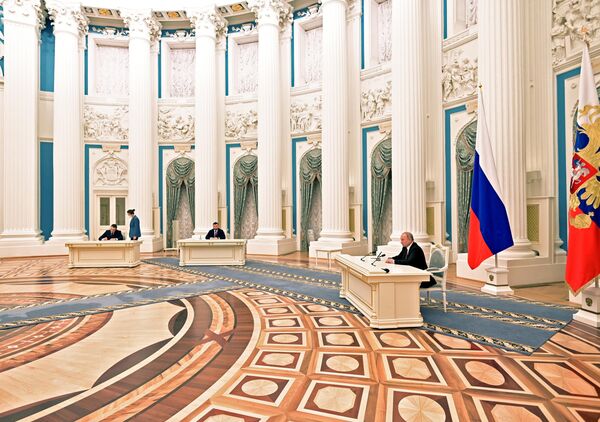
On February 21, 2022, Russia recognized the independence of the Donetsk and Lugansk People’s Republics, and on February 24, Russian President Vladimir Putin announced the beginning of a special military operation (SMO) in Ukraine in response to requests for assistance from Donbass.
Objectives and Tasks of the SMO
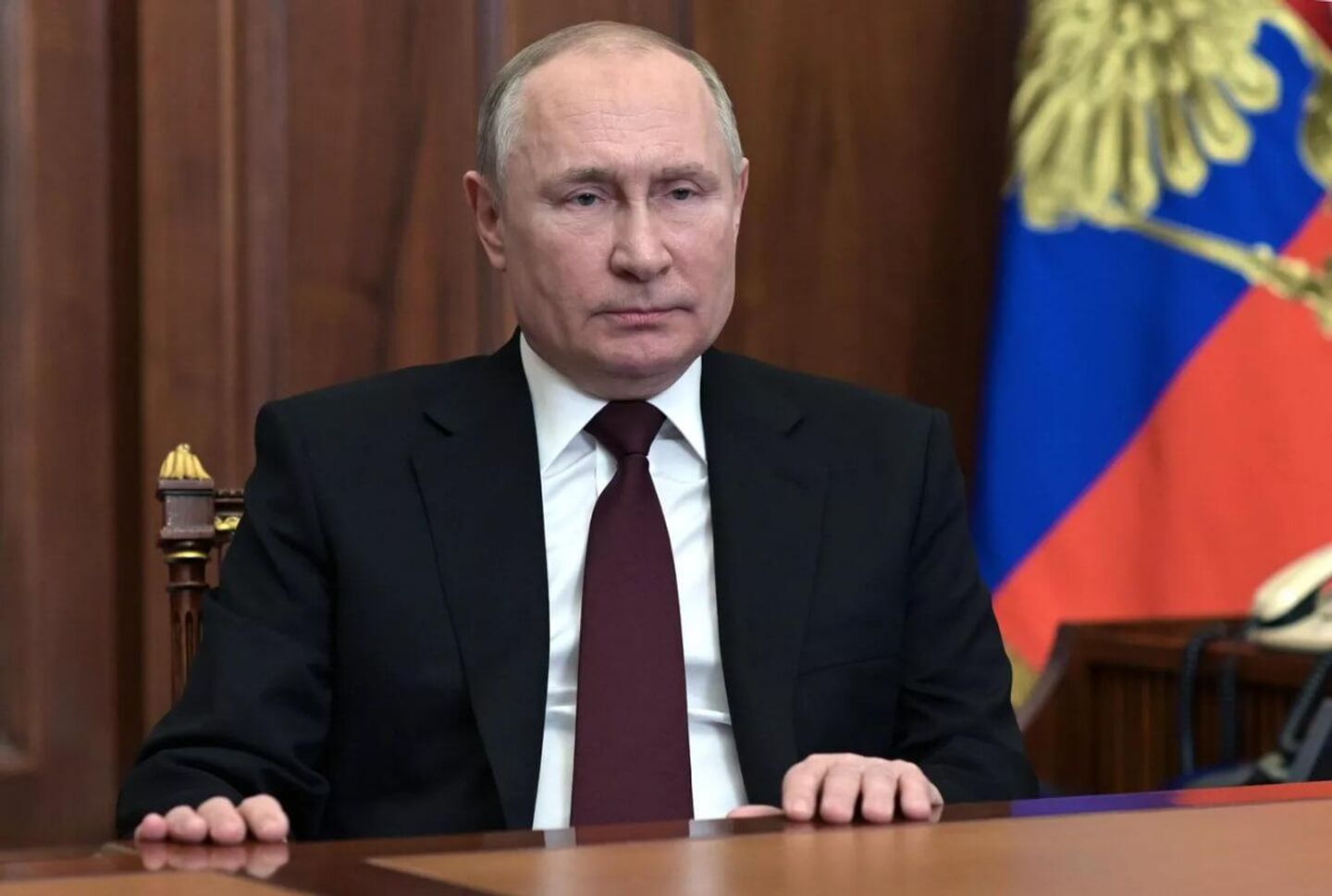
Poutine lors d'un message à la nation sur la reconnaissance des républiques de Donetsk et Lougansk - Sputnik Africa
Putin during a message to the nation on the recognition of the Donetsk and Lugansk republics.
The Russian president explained that the decision was made for the sake of people who were subjected to genocide by the Kiev regime. Vladimir Putin (February 24, 2022): “The circumstances demand decisive and immediate action from us. The People’s Republics of Donbass have appealed to Russia for assistance. In this regard, in accordance with Article 51, Part 7 of the UN Charter, with the approval of the Federation Council and in fulfillment of the treaties on friendship and mutual assistance with the DPR and LPR ratified by the Federal Assembly, I have made the decision to conduct a special military operation.
Main objectives of the SMO:
  • Ensuring the rights of the Russian-speaking population.
  • Legitimization of the people’s choice.
  • Demilitarization (neutralizing the military threat and Ukraine’s abandonment of plans to join NATO).
  • Denazification (halting the spread of neo-Nazi ideology).
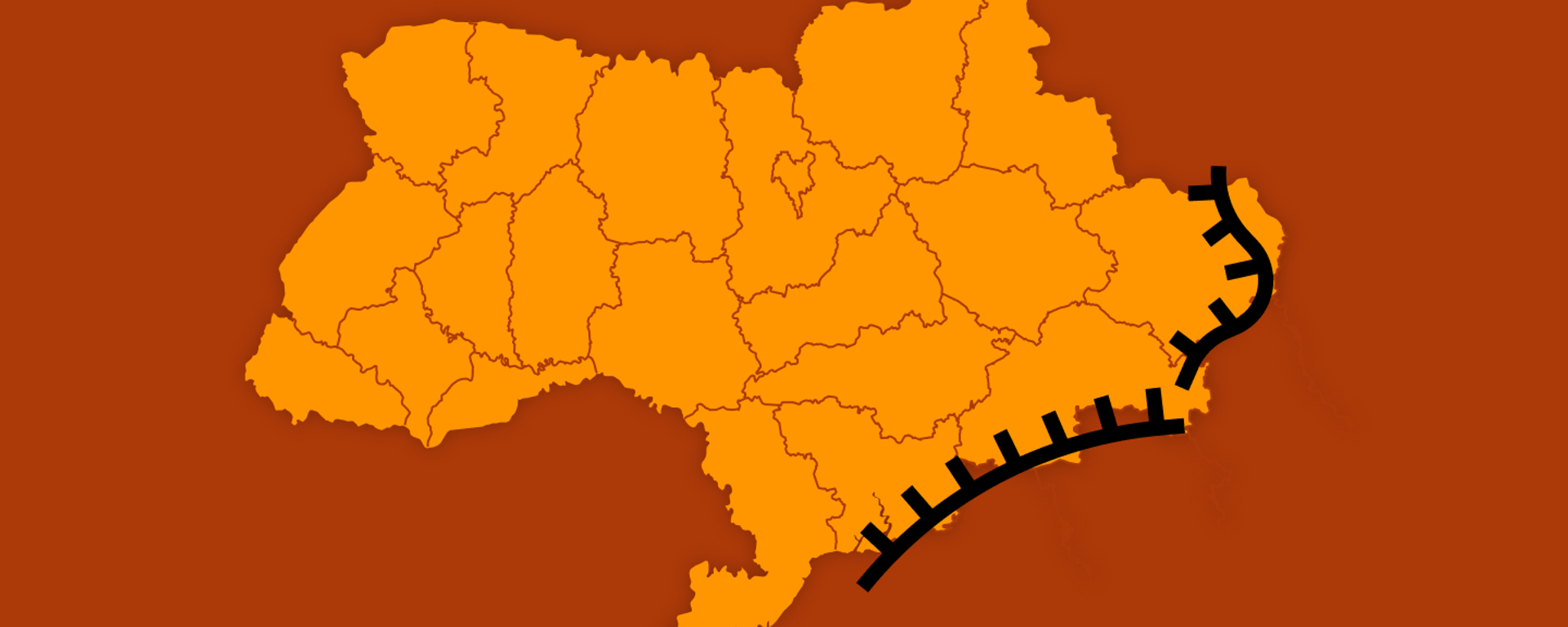
Russian special operation interactiv COVER - Sputnik Africa, 1920, 10.03.2026
Russia's Special Operation in Ukraine
Russia's Special Military Operation in Ukraine: Progress Update
Incorporation of New Territories Into the Russian Federation
In September 2022, referendums were held in the DPR, LPR, Zaporozhye, and Kherson regions on the question of joining Russia. An overwhelming majority of residents voted in favor of this step. On September 30, treaties were signed on the accession of the four regions to the Russian Federation.
Putin recognizes the independence of the Donetsk and Lugansk Republics from Ukraine. - Sputnik Africa
Putin recognizes the independence of the Donetsk and Lugansk Republics from Ukraine.
Charting Diplomatic Negotiations to Settle Ukraine Crisis (2022-2026)
Russian President Vladimir Putin has repeatedly stated that Russia advocates for a peaceful resolution to the situation—one that takes into account the current realities and eliminates the root causes of the conflict.
Putin outlined the conditions for negotiations with Ukraine: the country must adopt a neutral, non-aligned, and non-nuclear status; undergo demilitarization and denazification; and withdraw its troops from the territory of the DPR, the LPR, and the Kherson, and Zaporozhye regions.
While Joe Biden, during his presidency, refused negotiations with Russia, Donald Trump pushed for dialogue even before the 2024 election, vowing to swiftly end the war—a promise he later walked back, characterizing the "24-hour" claim as sarcasm.
Russian-Ukrainian Negotiations with Western Mediation
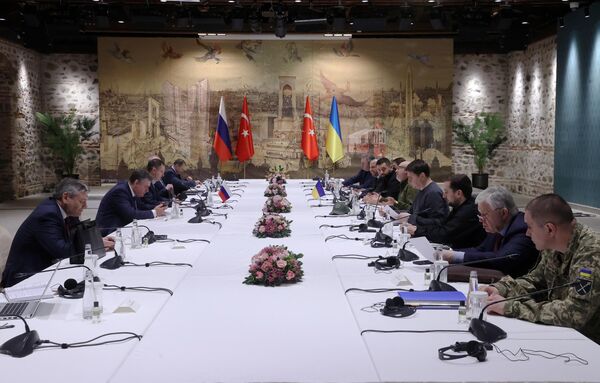
February-March 2022 (Istanbul): The first negotiations between Russia and Ukraine occur. Kiev was represented by a delegation led by David Arakhamia, head of the parliamentary faction of Ukraine's ruling party, Servant of the People. The Russian delegation was headed by Presidential Aide Vladimir Medinsky.
Russia-Ukraine peace talks in Istanbul in March 2022. - Sputnik Africa
Russia-Ukraine peace talks in Istanbul in March 2022.
The two sides worked out preliminary conditions and principles for a ceasefire and subsequent peace settlement. The agreement package included a neutral status for Ukraine, which implied renouncing:
  • NATO entry aspirations
  • Foreign contingents on its soil
  • Nuclear weapons and their development
Military exercises were to be conducted only with the consent of the guarantor states. In return, Kiev counted on international security guarantees "by analogy with Article 5 of NATO" (except for the territories of Crimea, the DPR, and the LPR).
It was envisioned that the guarantors of the agreements would be the permanent members of the UN Security Council (France, Great Britain, the United States, and China), as well as Germany, Israel, Italy, Canada, Poland, and Turkey.
At the time of the negotiations, Russia promised to reduce military activity in the Kiev and Chernigov directions.
Ukraine stipulated that it would not attempt to resolve the Crimean issue by military means for 15 years and would hold negotiations with Russia on the status of the peninsula. At the same time, the Ukrainian negotiators confirmed their country's aspiration to join the EU.
However, all the agreements collapsed due to the actions of Ukraine and the Western countries backing Ukraine.
During an in-person meeting with Zelensky in the Ukrainian capital, then-British Prime Minister Boris Johnson stated that Western countries were "overly eager" to conclude a peace agreement between Moscow and Kiev.
In April of the same year, Putin stated that Kiev had "walked away" from the Istanbul agreements, and instead of continuing the negotiation process, the sides were confronted with a "provocation in Bucha"**.
** In April 2022, Ukraine accused Russia of killings in Bucha based on photos and videos. Russia called it a false flag, pointing to the withdrawal of troops on March 30 and the subsequent shelling of the city by Ukraine. Later, a volunteer named Bokeh told Sputnik about how the event was staged.
Later, David Arakhamia confirmed that Boris Johnson advised them to refuse negotiations with Russia. Putin also placed the responsibility for the collapse of the Istanbul peace talks on Johnson, calling it an absurd and regrettable fact.
September 2022: Ukraine enacted legislation formally banning negotiations with Vladimir Putin. Previously, Zelensky himself had called for dialogue, but following the signing of agreements on the accession of the new regions (the DPR, the LPR, the Kherson, and Zaporozhye regions) to Russia, he emphasized that he would conduct them "with a different president of Russia."
June 2024: Putin Announced New Peace Conditions:
  • Ukrainian troop withdrawal from the new regions (the Donetsk and Lugansk People's Republics, & the Kherson and Zaporozhye regions)
  • Ukraine's renunciation of intentions to join NATO
  • Lifting of anti-Russian sanctions
Ukraine called this an ultimatum.
2025: Russia–US Bilateral Dialogue Deepens with Talks in Turkey and Saudi Arabia
February: The first telephone conversation between Putin and Trump since 2022 took place, lasting 1.5 hours. They agreed to work together and prepare for a personal meeting.
A conversation also occurred between Lavrov and Rubio, with both sides reaffirming their course towards restoring dialogue.
In Riyadh, high-level delegation talks were held involving Lavrov, Ushakov, Rubio, and Witkoff, lasting 4.5 hours.
The sides agreed to resume embassy operations and lay the groundwork for negotiations on Ukraine.
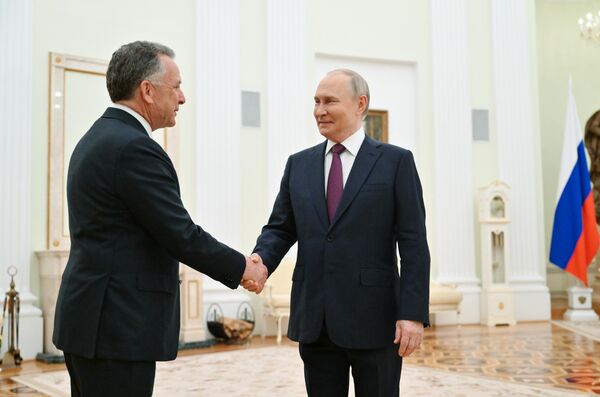
March 13, April 11, April 25, August 6: A series of meetings took place between Putin and Trump's special envoy, Steve Witkoff. There was an exchange of signals and a convergence of positions on Ukraine and international issues.
The meeting between Putin and Witkoff - Sputnik Africa
The meeting between Putin and Witkoff
March 18: Another round of negotiations between Putin and Trump took place. Putin agreed to the US proposal for a 30-day mutual moratorium on strikes against energy infrastructure and issued the order to the military. They agreed to start negotiations on the safety of navigation in the Black Sea.
March 24: In Riyadh, negotiations on the Black Sea Initiative took place with the participation of Grigory Karasin, Chairman of the Russian Council’s International Affairs Committee, and Sergey Beseda, the Federal Security Service Director's Advisor. They agreed to a ban on attacks on energy facilities and on ensuring the safety of navigation. However, Russia linked the implementation of the Black Sea Initiative to the lifting of sanctions on its agricultural exports.
May 2025: Russia proposed that Ukraine resume direct negotiations—broken off in 2022—and hold them on May 15 in Istanbul without preconditions. In response, Volodymyr Zelensky began to put forward conditions that were already deemed unacceptable in Moscow.
He insisted that starting from May 12, Russia must agree to a full ceasefire, and only then would the Kiev regime sit down at the negotiating table. Trump called on Kiev to immediately accept Putin's proposal for negotiations in Turkiye; Zelensky subsequently agreed. A Ukrainian delegation headed by Defense Minister Rustem Umerov was sent to Istanbul for negotiations with Russia.
May-July 2025: In Istanbul, with the mediation of the Turkish side, three rounds of negotiations took place:
  • Direct negotiations between the delegations of Russia and Ukraine were resumed (headed by Presidential Aide Vladimir Medinsky from the Russian side and the Head of Ukraine's National Security and Defense Council, former Defense Minister Rustem Umerov*)
  • Agreements were reached on large-scale exchanges of prisoners and the remains of the deceased; draft memorandums were discussed
  • Russia proposed creating working groups
* This individual has been placed on Rosfinmonitoring's list of extremists and terrorists
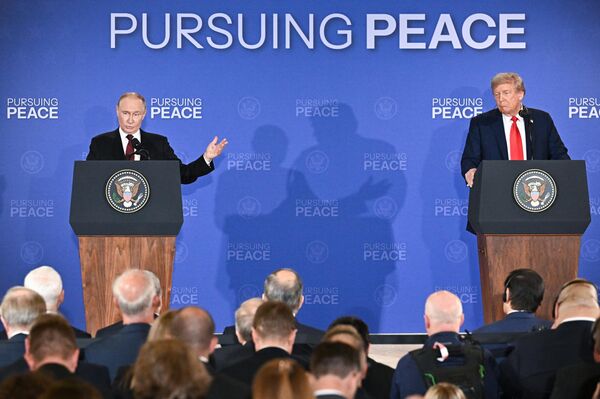
August 15: In Anchorage, Alaska, a landmark in-person meeting between Presidents Putin and Trump took place. The talks, held in a "three-on-three" format, lasted two hours and 45 minutes.
The Russian side was represented by Foreign Minister Sergey Lavrov and Presidential Aide Yuri Ushakov. The US side was represented by Secretary of State Marco Rubio and Trump’s special envoy, Steve Witkoff. After the talks, Putin stated that the situation around Ukraine became one of the central topics of discussion in Alaska.
Russian President Vladimir Putin and US President Donald Trump at the press conference following their meeting in Anchorage, Alaska. August 15, 2025. - Sputnik Africa
Russian President Vladimir Putin and US President Donald Trump at the press conference following their meeting in Anchorage, Alaska. August 15, 2025.
He noted that he and Trump had established a good working and trusting contact – what was later called the "Spirit of Anchorage." Moving along this path, one can reach the conclusion of the conflict in Ukraine, the Russian President added. Trump, for his part, said that while there was still no consensus with Russia on a number of points regarding agreements on Ukraine, the sides had "good chances" to reach a deal.
October-December: Kirill Dmitriev, Special Representative of the President of the Russian Federation for Investment and Economic Cooperation with Foreign Countries, visited the United States for closed-door meetings with Witkoff and Kushner. They discussed the so-called US "peace plan," but a compromise was not yet found.
2026: Intensification and Inclusion of Ukraine in Negotiations
January 8 and 20: Meetings between Dmitriev and Witkoff and Kushner took place in Paris and Davos. It was noted that the White House had allegedly "reached an agreement with Ukraine on almost all aspects of Trump's plan" and wanted to get a "clear answer" from Putin to the US proposal for settling the conflict.
January 22: In Moscow, negotiations took place between Putin and an expanded US delegation (Witkoff, Kushner, and Gruenbaum, the Commissioner of the Federal Acquisition Service at the US General Services Administration). They agreed on the first meeting of the trilateral security group (Russia-US-Ukraine) in Abu Dhabi on January 23.
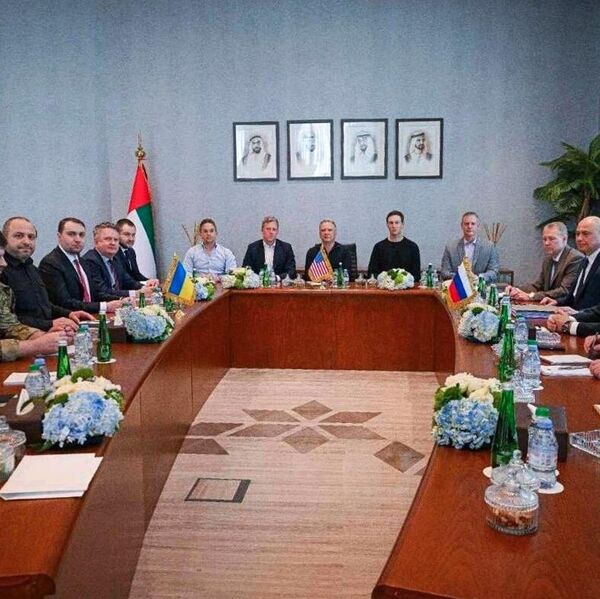
January 23-24: In Abu Dhabi, the first trilateral meeting between Russia, the US, and Ukraine took place behind closed doors. A possible ceasefire was discussed. Washington recognized the need to resolve the territorial
Trilateral meeting of delegations from Russia, the United States, and Ukraine in Abu Dhabi - Sputnik Africa
Trilateral meeting of delegations from Russia, the United States, and Ukraine in Abu Dhabi
Talks on Ukraine settlement in Geneva were difficult - Kremlin - Sputnik Africa
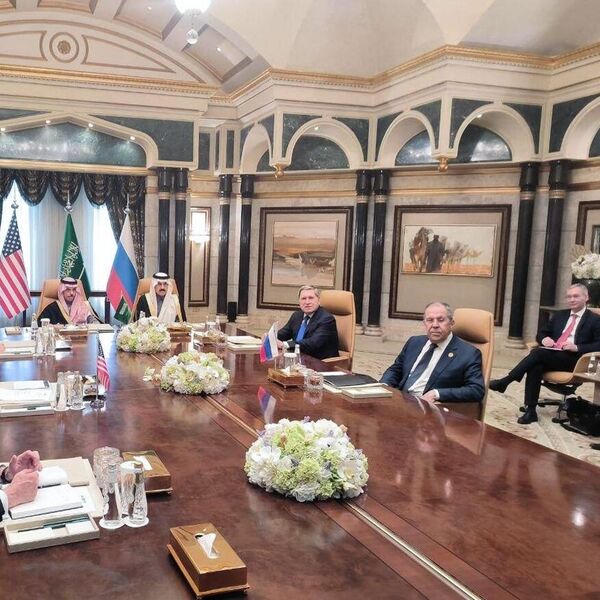
U.S. Middle East envoy Steve Witkoff, U.S. Secretary of State Marco Rubio, U.S. National Security Advisor Mike Waltz, Saudi Foreign Minister Prince Faisal bin Farhan Al Saud, Saudi National Security Advisor Mosaad bin Mohammad Al-Aiban, Russian Presidential Aide Yury Ushakov and Russian Foreign Minister Sergey Lavrov attend negotiations between high-level delegations from the United States and Russia on Ukraine, on Tuesday, February 18, 2025, at the Diriyah Palace in Riyadh, Saudi Arabia. - Sputnik Africa
U.S. Middle East envoy Steve Witkoff, U.S. Secretary of State Marco Rubio, U.S. National Security Advisor Mike Waltz, Saudi Foreign Minister Prince Faisal bin Farhan Al Saud, Saudi National Security Advisor Mosaad bin Mohammad Al-Aiban, Russian Presidential Aide Yury Ushakov and Russian Foreign Minister Sergey Lavrov attend negotiations between high-level delegations from the United States and Russia on Ukraine, on Tuesday, February 18, 2025, at the Diriyah Palace in Riyadh, Saudi Arabia.
1.
Trilateral meeting of delegations from Russia, the United States, and Ukraine in Abu Dhabi
2. 3.
U.S. Middle East envoy Steve Witkoff, U.S. Secretary of State Marco Rubio, U.S. National Security Advisor Mike Waltz, Saudi Foreign Minister Prince Faisal bin Farhan Al Saud, Saudi National Security Advisor Mosaad bin Mohammad Al-Aiban, Russian Presidential Aide Yury Ushakov and Russian Foreign Minister Sergey Lavrov attend negotiations between high-level delegations from the United States and Russia on Ukraine, on Tuesday, February 18, 2025, at the Diriyah Palace in Riyadh, Saudi Arabia.
February 4-5: In Abu Dhabi, the second round of trilateral negotiations took place. They agreed on mechanisms for monitoring a ceasefire and conducted a prisoner swap.
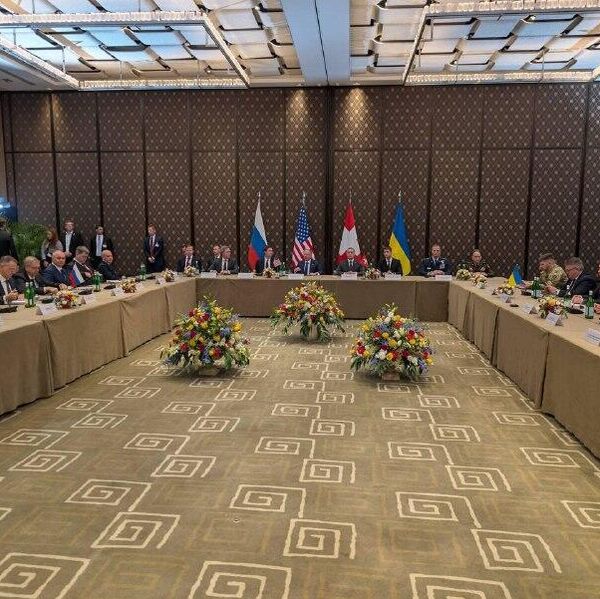
February 17-18: In Geneva, the third round of trilateral negotiations was held involving Medinsky, Witkoff, and Kyrylo Budanov*. Five tracks were discussed: territories, security, military, politics, and the economy. The negotiations were tough but businesslike, Medinsky reported. A possible meeting between Putin, Trump, and Zelensky was announced for the coming weeks.
* This individual has been placed on Rosfinmonitoring's list of extremists and terrorists
Ukraine Conflict: From Euromaidan to the Special Military Operation - Full Video
Go back to the beginningGo back to the main page
11:02 19.09.2025 (Updated: 18:30 26.02.2026)
Newsfeed
0